LLMs for Design & Manufacturing
Project facts
- Status
- Completed
- Methods
- Applications
tl;dr
Early explorations and findings of GPT-4 as a design agent.
Important links
Paper · 2024
How Can Large Language Models Help Humans in Design and Manufacturing? Part 1: Elements of the LLM-Enabled Computational Design and Manufacturing Pipeline
Liane Makatura, Michael Foshey, Bohan Wang, Felix Hähnlein, Pingchuan Ma, Bolei Deng, Megan Tjandrasuwita, Andrew Spielberg, Crystal Owens, Peter Yichen Chen, Allan Zhao, Amy Zhu, Wil Norton, Edward Gu, Joshua Jacob, Yifei Li, Adriana Schulz, Wojciech Matusik · Harvard Data Science Review, Special Issue 5: Grappling With the Generative AI Revolution
PDFDOI 10.1162/99608f92.cc80fe30
Paper · 2024
How Can Large Language Models Help Humans in Design And Manufacturing? Part 2: Synthesizing an End-to-End LLM-Enabled Design and Manufacturing Workflow
Liane Makatura, Michael Foshey, Bohan Wang, Felix Hähnlein, Pingchuan Ma, Bolei Deng, Megan Tjandrasuwita, Andrew Spielberg, Crystal Owens, Peter Yichen Chen, Allan Zhao, Amy Zhu, Wil Norton, Edward Gu, Joshua Jacob, Yifei Li, Adriana Schulz, Wojciech Matusik · Harvard Data Science Review, Special Issue 5: Grappling With the Generative AI Revolution
PDFDOI 10.1162/99608f92.0705d8bd
Explanation
This two-part study investigates how GPT-4 can assist people throughout design and manufacturing. Part 1 examines generating geometry, exploring variations, preparing manufacturing instructions, evaluating performance, and finding better designs. Part 2 combines these steps into complete workflows that produce a cabinet and a quadcopter.
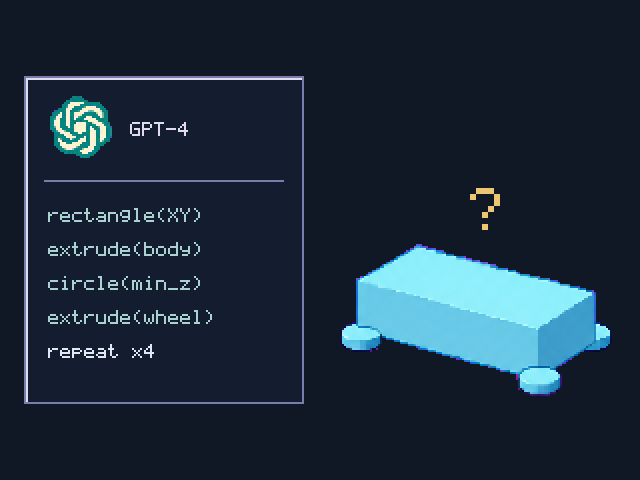
The car example in Part 1, Appendix B.4, Figure B11 exposes a spatial-reasoning error: GPT-4 places wheel circles on the body’s bottom plane and extrudes them vertically, leaving their circular faces horizontal. The animation preserves that mistake as a dialogue-driven sequence of CAD operations.
Both papers first appeared as peer-reviewed Just Accepted releases on May 28, 2024. Their final versions were released on December 23, 2024, in Harvard Data Science Review, Special Issue 5, on the PubPub platform.
Related Projects
Co-Learning Tasks and Sensor Placement
A neural network learns where a soft robot needs sensors and how to interpret their signals together. Sparse sensing supports body-shape reconstruction, touch perception, and control across different robot forms.
Efficient Automatic Robot Design
Optimized in 30 seconds or your robot's free!
MemGlove
A simple, inexpensive glove for multimodal sensing and interaction.